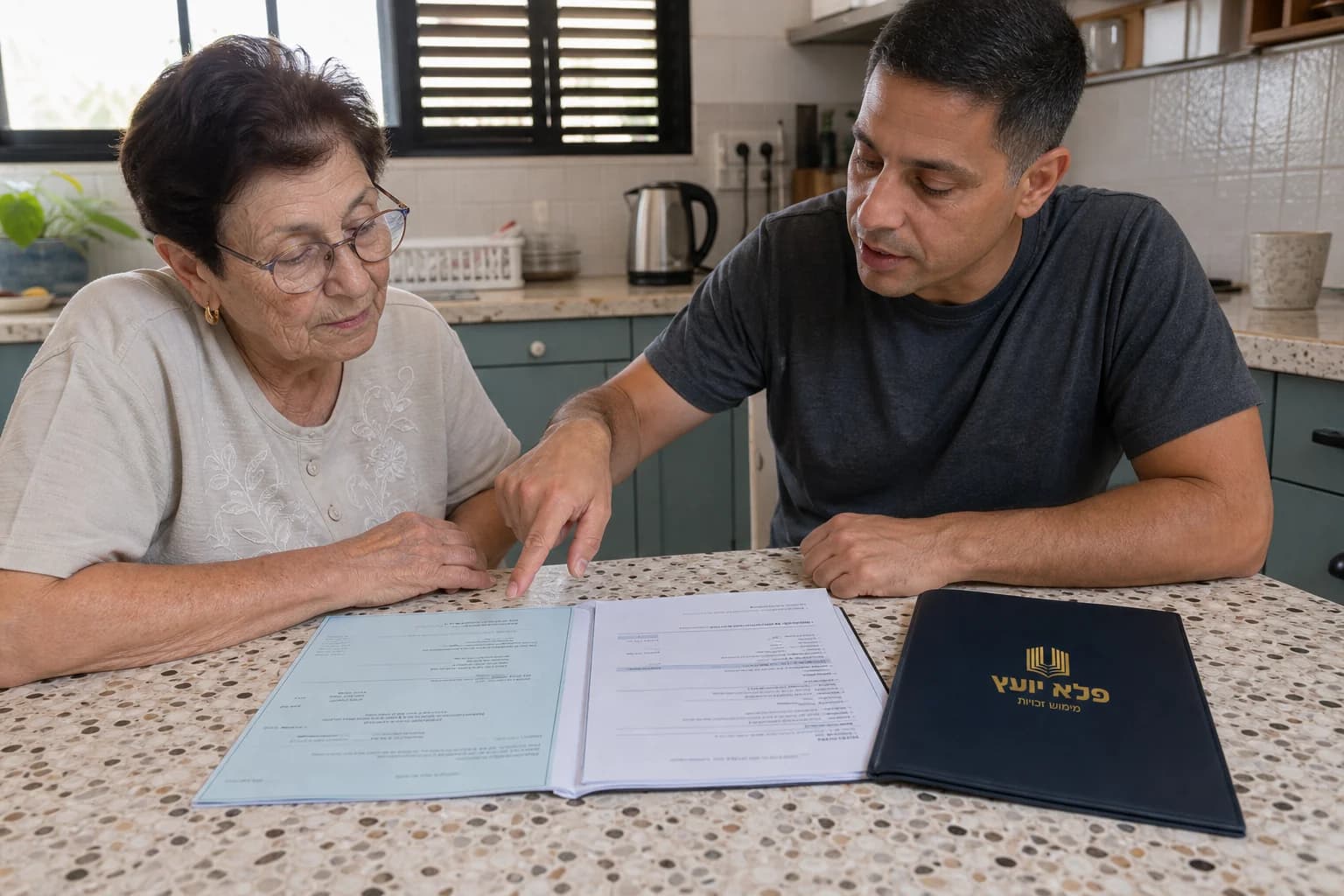

A practical guide to the first days: what to check first, which policies to look for, when to approach National Insurance, how to document daily function from day one, what not to send an insurer yet, and how to divide the load between siblings.
First: you do not have to do everything this week
If you have reached this page, something has probably happened — a hospital stay, a fall, discharge from rehabilitation, or simply the realisation that a parent is no longer managing alone. The first feeling is usually being overwhelmed: twenty things suddenly need attention and nobody knows where to begin.
The good news is that only a small part of it is genuinely urgent. Most of it can be done over weeks. What does matter immediately is one simple thing: start documenting. Everything you can see today — who helps with the shower, how long dressing takes, when there was a fall — will be worth a great deal in two months, and impossible to reconstruct in a year.
This page is ordered by real priority: what to do in the first days, what in the first weeks, and what can wait. It is written from the point of view of what serves the family, not as a theoretical checklist.
The first days: document and map, not forms
The most common mistake is rushing to file. A family that submits a claim a week after an event, with a discharge summary alone and no functional description, usually receives a refusal — and a refusal makes what follows harder.
What is worth doing straight away is starting a simple log. A notebook, a file on a phone, a family WhatsApp group — the format does not matter. What matters is that what actually happens is recorded, as it happens.
- Open a functional log: who helped, with what, when, and how long it took
- Record every unusual event — a fall, confusion, medication not taken
- Gather all the medical documents that already exist into one folder
- Photograph the discharge letter and everything handed over at the hospital
- Find out who the family doctor is and when an appointment can be arranged
- Do not yet send anything to an insurance company
The first weeks: find out what exists
This stage is enquiry, not filing. The only question you are answering right now is: what cover and entitlements exist at all.
Almost always, things turn up that the family did not know about. A private long-term care policy bought twenty years ago, cover through an old workplace, insurance through the health fund that nobody remembered. In more than a few cases there is more than one policy.
In parallel, check the public route — the long-term care benefit from National Insurance. That is an entirely separate track, with its own form and its own assessment, and both can be pursued at the same time.
- Check Har HaBituach, the Capital Market Authority registry, for existing cover
- Search for old insurance documents at home and in cupboards
- Go through bank statements looking for standing orders to insurers
- Check the personal area on the health fund's website
- Find out whether there was cover through a workplace or an organisation
- Check eligibility for the National Insurance long-term care benefit
What not to send an insurer — and why
This is one of the most useful things to know in advance, and nobody says it. Once you begin passing documents across, they go into the file — and getting them out again is very difficult.
There is no reason to rush. Before filing, it is worth knowing exactly what the policy definition requires, which form is needed, and what material supports the claim. Sending a complete medical file, unselected, can put records into the file that are irrelevant — and even records describing a period when the condition was better.
A simple rule of thumb: send nothing until you have read the policy and know what is being assessed. A phone call with a representative is not an opportunity to describe the situation out loud either — what is said may be recorded.
- Do not send a complete medical file unselected and unchecked
- Do not describe the situation by phone before a written description is prepared
- Do not sign a blanket confidentiality waiver without understanding its scope
- Do not file before reading the definition in the policy
- Do not send documents through any channel other than the insurer's official one
Power of attorney, guardianship and who is authorised to act
This is the issue that most often stalls families midway, so it is worth dealing with early. The moment you file a claim, the insuring body will ask who may receive information, who signs and who receives payment.
If the parent is competent and lucid, the simplest course is to arrange their signatures in advance, and to consider an enduring power of attorney while they still can. If significant cognitive decline already exists, a guardianship process may be required — and that takes time.
The practical advice: establish with the insuring body exactly which authorisation documents it accepts, while you are still at the enquiry stage. Discovering this need after the claim has been filed can cost months.
A foreign worker, a carer and help at home
If you are considering or already employing a carer, note two things. First: the employment itself is a strong indication of a need for functional help, so it strengthens the file — provided it is documented.
Second: if the policy is an indemnity policy, evidence of expenditure may be required. So keep the employment contract, payslips, receipts and confirmations from the outset. Collecting them retroactively a year later is very hard.
Employing a foreign worker in care requires a permit and a process with the Population and Immigration Authority. That is a separate track from the insurance, but it is relevant to the full picture and to the documentation.
Dividing the load between siblings
Almost every family develops the same pattern: one sibling carries most of the weight and the others help less. It is a source of tension, but it also has a practical consequence for the claim.
When several family members telephone the insurer and give slightly different accounts, or send documents twice over, the file looks disorganised. So the clear recommendation is to choose one family member to hold the communication with the institutions.
The division can be completely different in every other area — who visits at weekends, who sorts medication, who handles money. But facing the insurer and National Insurance, one voice is better.
The order of steps, in one place
If you want a single list to take away, this is it. It is ordered by sequence rather than importance — each step prepares the one after it.
- 1. Start a functional log today, even if nothing is clear yet
- 2. Gather every existing medical document into one folder
- 3. Check Har HaBituach and old paperwork for what cover exists
- 4. Check eligibility for the National Insurance benefit in parallel
- 5. Find out which authorisation documents are required, and arrange them early
- 6. Read the definition of an LTC condition in the policy you found
- 7. Choose one family member to hold the communication
- 8. Only then — download the current form and begin filing
Frequently asked questions
What is the first thing to do when a parent becomes dependent?
Start documenting. A simple log describing who helps, with what, when and how long it takes will be worth a great deal later and is impossible to reconstruct after the fact. Filing forms can wait.
How long do we have before we need to file a claim?
There is no pressure to file within days, but it should not be postponed indefinitely either. Dates matter — both for the period a benefit is assessed for and for the question of prescription. A reasonable order of magnitude is to complete the enquiry within weeks, not years.
Should we send all the medical documents to the insurer?
No. A document that enters the file is hard to remove. It is better to read the definition in the policy first, identify what is relevant, and send focused, current material.
Do we need guardianship to handle a claim for a parent?
Not always. If the parent can sign, their signature is usually enough. Where they cannot, an enduring power of attorney that has come into effect or a court appointment may be required. Establish the requirement early, because arranging it late causes delay.
We already employ a carer — does that help the claim?
Yes, when it is documented. Employing a carer is an indication of a need for functional help. If the policy is an indemnity policy, keep the contract, payslips and receipts from the outset.
Can we check both National Insurance and an insurer at the same time?
Yes, and it is advisable. They are entirely separate tracks assessed under different rules, and recognition by one does not guarantee recognition by the other.
Official sources for further checking
This is general information and does not replace personal medical, legal or insurance advice. Eligibility is determined by the documents and rules that apply to each case.