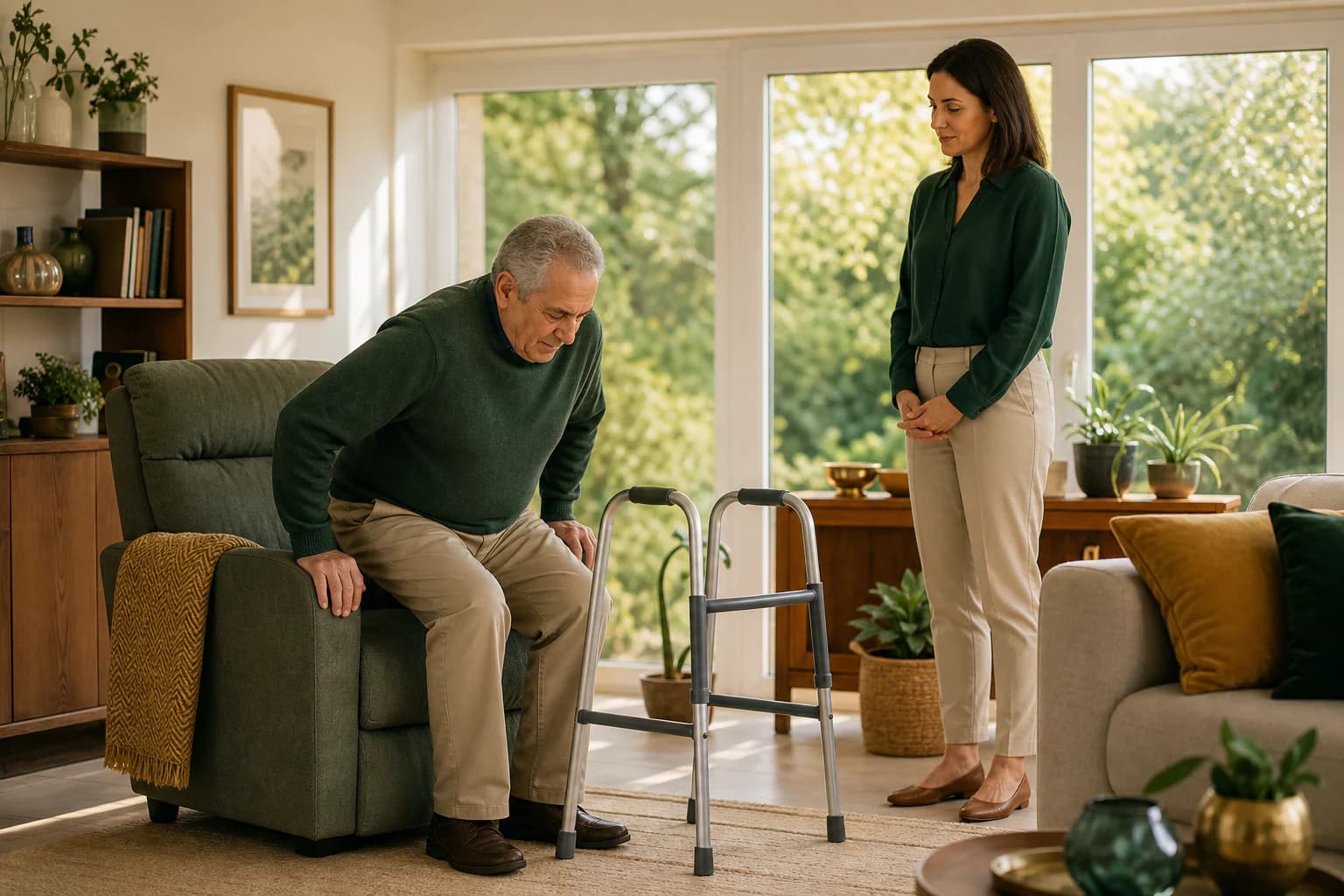

A full guide to the ADL assessment and the dependency test: which six daily activities are examined, the difference between ADL, IADL and BADL, how each activity is scored, how to prepare for a functional assessment at home, and how to describe help without overstating or understating it.
In brief: what is the ADL assessment?
ADL stands for Activities of Daily Living — the basic everyday actions a person performs in order to function independently. The ADL assessment, known in Israel also as the dependency test or the functional assessment, examines how far the person can carry out those actions alone and how much help they need from others.
This test sits at the heart of almost every decision in the field: it is the basis for setting the level of the National Insurance long-term care benefit, and it is also the tool insurers and health funds use to check whether the definition of an "LTC condition" in the policy has been met.
It is important to understand that there is no single, uniform ADL test. Each body may use slightly different wording, scoring and thresholds, so a person can be considered dependent under one route and not under another. That is one reason a refusal in one place is not a conclusion about another.
The six daily activities examined
Most definitions in Israel rest on six basic activities. Insurance policies commonly require an inability to perform a defined number of them — sometimes three, sometimes another figure — which is exactly why the precise wording in the policy is critical.
Alongside the six, the need for supervision is assessed separately. Someone technically able to perform the activities but unsafe alone because of cognitive decline may enter the definition through the mental frailty route.
- Washing — getting in and out of the shower or bath, washing and drying
- Dressing — putting on and taking off clothes, including buttons, zips, socks and shoes
- Eating and drinking — bringing prepared food to the mouth and swallowing safely
- Mobility — walking inside the home and moving between rooms, with or without an aid
- Getting up and lying down — transfers between bed, chair and wheelchair
- Continence — control of bladder and bowel and the care required
ADL, BADL and IADL: the difference
The professional literature distinguishes two kinds of activity. BADL — Basic Activities of Daily Living — are the actions that sustain the body itself: washing, dressing, eating, mobility, transfers and continence. These are the six listed above, and they form the basis of most insurance and long-term care definitions.
IADL — Instrumental Activities of Daily Living — are more complex actions that make independent life in the community possible: managing money, taking medication at the right time and dose, using the telephone, shopping, cooking, cleaning and getting about outside the home.
The distinction matters a great deal to families. A decline in IADL is usually the first sign — a person stops managing their account, gets confused with medication, stops cooking. But in most insurance definitions, a decline in IADL alone is not enough to meet the definition of an LTC condition. It is, however, highly relevant when mental frailty and the need for supervision are being assessed.
How each activity is scored
The assessor does not simply ask "yes or no". In most professional tools, the degree of independence in each activity is assessed separately, on a scale running from full independence to complete dependence, with intermediate levels.
The differences between those levels are substantial, and this is where many families come unstuck. "He showers alone but I stand outside" is not full independence — that is supervision. "She dresses herself but I lay out the clothes and help with the socks" is not independence either — that is partial help.
So during the assessment it is worth describing the activity as it actually happens, step by step, rather than giving a general answer. Someone who says "I manage" out of pride may receive a score that does not reflect reality.
- Fully independent — performs the activity without any assistance or supervision
- Independent with an aid — uses a walking frame, grab rail or shower chair
- Needs supervision or prompting — performs it alone but is not safe without someone present
- Needs partial help — part of the activity is carried out by another person
- Fully dependent — the activity is carried out entirely by another person
How to prepare for a functional assessment at home
Proper preparation is not rehearsing answers, and it is not presenting a condition worse than reality. It is organising facts that are hard to recall under the pressure of the moment, when a stranger is sitting in the living room asking questions.
The simplest approach is to go through an ordinary day from morning to night and write down: who helps, with what, how long it takes, and what happens on days when there is no help. A week of that short record is worth more than any attempt to explain it verbally.
The common mistake in the opposite direction is trying to present a worse picture than the truth. Experienced assessors notice inconsistency between the description, the documents and what they observe, and inconsistency damages the credibility of the whole file — including the parts that are accurate.
- Write down a week of routine: who helped, when, and with which activity
- Have the current medical documents together in one folder
- Show the aids in use — walking frame, shower chair, adjustable bed
- Make sure a family member or carer who knows the routine is available
- Do not tidy the house in a way that hides the daily difficulty
- Describe frequency in numbers — "three times a week", not "sometimes"
Forms and assessments: what is available and what is not
Families often look for a functional assessment form to download or complete themselves. It is important to know that the ADL assessment that determines entitlement is carried out by an authorised professional on behalf of the assessing body — National Insurance, the insurer or the health fund — and not by the family.
A form completed independently and sent on the family's initiative does not replace the official assessment. It can serve as an internal aid: organising your thoughts, making sure no area has been overlooked, and arriving prepared.
Where a functional document signed by a professional is required — for example a report from a treating doctor, a nurse or an occupational therapist — approach the treating professional and ask that it refer explicitly to daily activities, not only to diagnoses.
ADL in an insurance claim versus the National Insurance benefit
At National Insurance, the results of the dependency test translate into a level of entitlement that determines the scope of the service basket. The assessment is carried out at home, and the rules are uniform for all claimants.
At an insurer or health fund, the same activities are assessed against a contractual definition. The policy sets how many activities a person must be unable to perform in order to be considered in an LTC condition, and exactly what "unable to perform" means. Two policies with the same product name can differ on this point.
The practical conclusion: before preparing for an assessment on behalf of an insurer, read the definition in the policy itself. A description emphasising precisely the areas the definition addresses serves the file better than a general, broad account.
What to do when the result does not match reality
When the decision arrives and does not square with what happens at home, the first step is not an appeal but reading the assessment report itself. It shows what was recorded in each area, and it often turns out that an entire area was mistakenly recorded as independent, or that a material medical document was not before the assessor.
Only once you have identified the precise gap can you build an effective approach: quote what was recorded, explain what actually happens, and attach the document that supports it. A general request to "reconsider", without pointing to a specific point, is refused in most cases.
Pele Yoetz helps read the assessment report, identify the gaps and present function factually. This is not medical or legal advice, and there is no promise that a decision will change.
Frequently asked questions
What is the ADL assessment?
An assessment of basic daily activities — washing, dressing, eating, mobility, transfers and continence — that examines how far a person depends on the help of others. It is used to set the level of the National Insurance long-term care benefit and to test whether the definition of an LTC condition in an insurance policy has been met.
What is the difference between ADL and IADL?
Basic ADL (BADL) covers survival-level actions such as washing, dressing and eating. IADL covers more complex actions such as managing money, medication, shopping and cooking. Most insurance definitions rest on BADL, while IADL is particularly relevant to assessing mental frailty.
How many ADL activities must a person be unable to perform to be considered in an LTC condition?
The number is set in the policy wording or in the rules of the route, and it is not uniform. Many policies require an inability to perform several of the six, but you should follow the definition written in the document that applies to the insured person.
Can I download a functional assessment form and complete it myself?
An assessment that determines entitlement is carried out by an authorised professional on behalf of the assessing body, not by the family. A self-completed form can serve as internal preparation only and does not replace the official assessment.
What is BADL?
BADL stands for Basic Activities of Daily Living — washing, dressing, eating, mobility, transfers and continence. These are the activities at the centre of most definitions of an LTC condition.
Someone showers alone but needs another person in the house — are they independent?
Not necessarily. Needing presence or supervision to prevent danger is not treated as full independence in most professional tools, and it is important to state this explicitly during the assessment.
Is the assessment always carried out at home?
At National Insurance the assessment is usually carried out at the insured person's home. With insurers and health funds, the place and nature of the examination are set by the insuring body's procedures and by the policy.
Official sources for further checking
This is general information and does not replace personal medical, legal or insurance advice. Eligibility is determined by the documents and rules that apply to each case.