A guide to preparing for a National Insurance dependency assessment: what is actually examined, who comes, what to prepare in advance, which mistakes lower the level awarded, and what to do when the result does not match.
The stage that decides the level
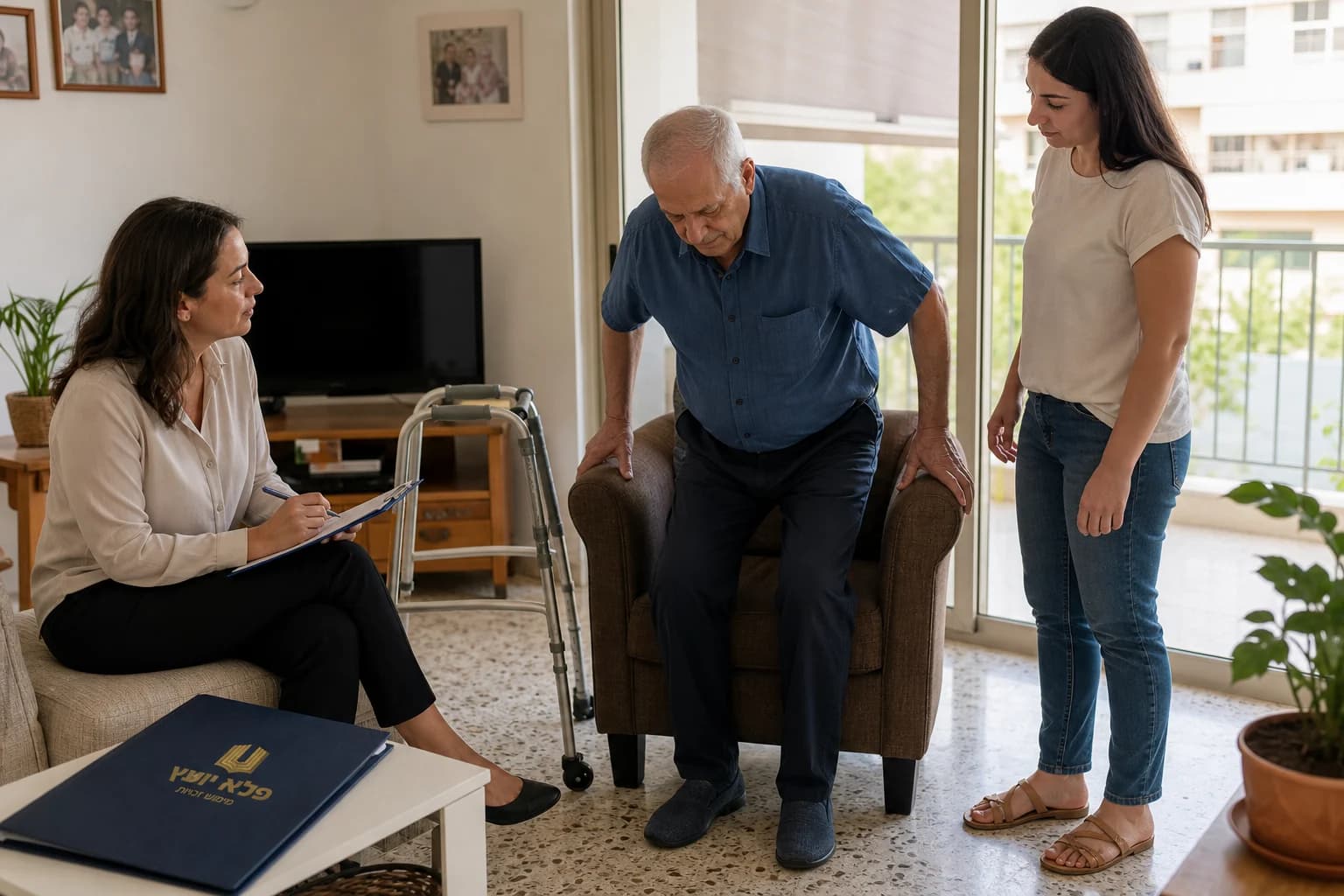
In a claim for the long-term care benefit the documents matter — but it is the dependency assessment that actually determines the level. A professional on behalf of National Insurance comes to the home and examines how far the person depends on the help of others.
Many families treat this as a technical visit. In practice, what is recorded in that hour will follow the file over time, and will affect the scale of assistance provided.
The good news: preparing well takes little effort, and it does not involve presenting a situation that is not true. It is mainly a matter of organising facts.
What is actually examined
The assessment focuses on daily activities and on the need for supervision. The assessor asks, observes, and sometimes asks for an activity to be demonstrated.
It is important to understand that they are not only checking whether the activity can be performed, but to what extent, how often and with what assistance. Someone who manages to shower once a week with close accompaniment is not in the same position as someone who showers daily on their own.
- Bathing — getting in, getting out, washing, drying
- Dressing — choosing a garment, buttons, socks and shoes
- Eating — bringing food to the mouth, swallowing
- Mobility at home — walking, using aids
- Transfers — rising from the bed, the chair, the toilet
- Continence and the care it requires
- The need for supervision — safety, orientation, taking medication
What to prepare before the visit
Preparing is not rehearsing answers. It is organising information that is hard to recall under the pressure of the moment, when a stranger is sitting in the living room.
- A written list of who helps with each activity, when and how often
- A functional diary, if you have kept one — it answers frequency questions with confidence
- Up-to-date medical documents in one folder, within reach
- An up-to-date list of medication
- The aids in their usual place — walking frame, shower chair, adjustable bed
- The presence of a family member or carer who knows the daily routine
The mistakes that lower the level
There is a recurring pattern that produces a level lower than the situation warrants, and it is almost never deliberate.
The most prominent: the older person makes an effort to present independence. It is an entirely human response — pride, embarrassment, or a wish not to appear weak. They get up quickly from the chair, say they are managing, and play the difficulty down.
The second mistake: tidying the house in a way that conceals reality. Putting the walking frame away, a thorough clean, food prepared in advance. The intention is good, the effect is the opposite.
The third mistake: vague answers. "Sometimes", "a bit", "it depends". Whoever is recording has to write something down, and a vague answer is usually recorded in favour of independence.
What to do instead
Answer honestly and in numbers. Instead of "sometimes she needs help in the shower" — "she showers twice a week, and each time my daughter is there and helps her get in, washes her back and dries her".
Describe the ordinary day and not the good day. If the day the assessment takes place is better than usual, say so explicitly.
Give examples of incidents: falls, confusion, occasions when medication was not taken. And if something was not asked about but is relevant, you can raise it.
And finally: explain to the older person in advance that there is nothing to prove. This is not an examination, and there is no prize for looking strong.
After the assessment
Make a note for yourselves of what was examined and what was asked. If a decision later arrives that does not match, that note will help you understand where the gap arose.
When the decision comes, you can ask for the detailed assessment report rather than settling for the letter. The report shows what was recorded in each area — and that is the starting point for any approach.
If the level is lower than the situation warrants, there is an option to appeal within the set deadline. Do not put off looking into it, because the deadlines are not flexible.
Frequently asked questions
Who comes to the National Insurance dependency assessment?
A professional on behalf of the National Insurance Institute, who usually comes to the insured person's home and examines the degree of dependency on the help of others and the need for supervision.
What is examined in a dependency assessment?
Daily activities — bathing, dressing, eating, mobility, transfers and continence — as well as the need for supervision in terms of safety, orientation and taking medication.
How do you prepare for the assessment?
Prepare a written list of who helps with each activity and how often, up-to-date medical documents somewhere accessible, and make sure the aids are in their usual place and that a family member who knows the routine will be present.
What is the commonest mistake in the assessment?
That the older person makes an effort to present independence out of pride or embarrassment. Other mistakes: tidying the house in a way that conceals reality, and vague answers such as 'sometimes', which are usually recorded in favour of independence.
What do we do if the level determined is too low?
Ask for the detailed assessment report to see what was recorded in each area, and check the deadline for lodging an appeal. The deadlines are not flexible, so do not put off looking into it.
Should we tidy the house before the visit?
No, and it is better not to. Putting aids away or a thorough clean create a picture that does not reflect the daily routine and may lead to a level lower than is appropriate.
Official sources for further checking
This is general information and does not replace personal medical, legal or insurance advice. Eligibility is determined by the documents and rules that apply to each case.